Hierarchy of control.

The “Hierarchy of Controls” should be used at all times when implementing controls to eliminate the hazard or reduce the risk of a hazard causing loss / damage / injuries.

The hierarchy of hazard controls is a list which emphasizes controlling a hazard at the source.

This is done by giving preference to the use of the ‘engineering controls’ outlined in strategies 1 to 3 below. These types of strategies should be used, where possible, because they are less subject to human failure and because they are less disruptive and uncomfortable for people working in the area.
Back-up controls (such as PPE and administrative controls) should only be used as a last resort or as a support to other control measures.

In many cases, it will be necessary to use more than one control method.

Whichever methods you use, regular monitoring is important to  make sure that the control is working effectively and that exposure to the hazard is reduced or eliminated.

The hierarchy of controls is:


Elimination:
Obviously the most effective method will be to remove the hazard completely, if it is possible.

Substitution: 
 Replace the hazard with a lesser hazard. Be careful to assess what new risks the substitute may pose.

Engineering:
 
Make changes to the process, equipment or plant to reduce the hazard. e.g. change to ‘wet’ processes to reduce dust, enclose or isolate the hazard, install ventilation systems.

Administrative:
 
Establishing policies and procedures to minimize the risks, job scheduling to limit exposure, posting hazard signs, restricting access, training.

Behavior: 

Following safe work practices, workplace good housekeeping, personal hygiene practices.

PPE: 
Personal Protective Equipment provides a barrier between the wearer and the hazard. PPE items include respirators, safety goggles, blast shields, hard hats, hearing protectors, gloves, face shields, and footwear.

H2S (Hydrogen Sulfide) Training

H2S is a colorless, flammable gas that can be naturally present in most fossil fuels. It occurs as a byproduct of the production and processing of oil and natural gas. We often characterize our crude oil and gas fields as “sweet” or “sour” depending on the concentration of H2S. H2S can also be produced during metal refining, pulp and paper production, mining, and sewage and wastewater treatment.

Who is at Risk?


Anyone who works or lives around:
      Drilling rigs, Pipelines, Refineries,Gas plants
    Gas-oil separation plants (GOSPs)
    Sewers and wastewater treatment operations

What are the Hazards of H2S?

Toxic, Invisible, Heavier than air, Flammable and explosive, Corrosive and reactive

1. Toxic

H2S is toxic and can affect several different systems in the body. When inhaled it goes from the lungs into the bloodstream immediately, where it can rapidly paralyze the respiratory center in the brain and cause the lungs to cease to function, with death from asphyxiation (suffocation) following in minutes.


Concentration and Effects
0.10 ppm
Foul, rotten egg smells noticeable.
10 ppm
TLV-TWA; eye irritation; use SCBA.
15 ppm
Short-term exposure limit (STEL) for 15 minutes.
50 ppm
Maximum peak exposure (MPE).
100 ppm
IDLH; severe eye irritation, coughing, loss of sense of 
Smell in 1 to 5 minutes.
250 ppm
Pulmonary edema; gastrointestinal disturbance.
500 ppm
Dizziness; loss of consciousness within 30 minutes.
1,000 ppm
Death within minutes.
Above Table shows the toxic effects of the gas at different concentrations. The permissible exposure limit (PEL) for H2S at 10 ppm. This is the maximum H2S concentration a person is allowed to be exposed to over an average 8-hour day during a typical 40-hour workweek, also called the threshold limit value-time weighted average (TLV-TWA). When H2S concentration is suspected to be at 10 ppm, appropriate respiratory protection must be used. The short-term exposure limit (STEL) for H2S is 15 ppm for 15 minutes. Note that at 100 ppm, H2S is considered immediately dangerous to life and health (IDLH) and no work is allowed. Appropriate respiratory protection is a full-face respirator connected to either an auxiliary air supply or self-contained breathing apparatus (SCBA).

2. Invisible

H2S gas cannot be seen. H2S is colorless at room temperature so it cannot be detected with the naked eye. Low concentrations of the gas — even as low as 5 parts per billion — have a foul, rotten egg smell, but higher concentrations can quickly deaden your sense of smell — your nose becomes overpowered by the gas and stops sensing it completely. Never rely on the sense of smell to detect the presence of H2S.

3. Heavier than air

H2S is heavier than air. With poor ventilation, it tends to accumulate in low lying areas around drilling rig platforms, pipeline trenches, sewers, sumps and excavations. In confined spaces, H2S settles at the bottom, forming a deadly gas layer.

4. Flammable and explosive

H2S forms explosive mixtures with air and can ignite. H2S is extremely flammable and explosive over a wide range of concentrations in air. Its lower explosive limit (LEL) is 4.3% and its upper explosive limit (UEL) 46%. 
When H2S burns, it produces sulfur dioxide (SO2), which is a colorless and toxic gas that can severely irritate the eyes, nose, throat and respiratory system.

5. Corrosive and reactive

When H2S is combined with moisture in the air, it forms a corrosive acid called sulfuric acid that irritates the eyes and mucous membranes. It can also corrode metal, causing dangerous leaks in pipes, valves, tanks and other metal equipment. When H2S reacts with steel in pipes and other equipment it forms iron sulfide, which is pyrophoric — meaning it can ignite when dry and exposed to air.

Controlling the Hazards of H2S

We take all the reasonable precautions necessary to protect everyone from harmful exposure to H2S. The three basic approaches to controlling hazards are:
      Engineering controls
      Administrative controls
      Personal protective equipment (PPE)

1. Engineering controls

4 Safe and effective design, construction, operation and maintenance of drilling, work over, process, transportation and storage equipment.
4 Ventilation (using exhaust fans, air pumps).
4 Flaring systems (safely burn remaining gas).

Engineering controls offer the first line of defence against H2S hazards. Engineering controls or efforts to keep H2S away from people are by far the most effective controls for hazardous exposure to H2S. Some examples include safe design, construction and maintenance of drilling, work over, process, transportation and storage equipment. Additional engineering controls for H2S during routine equipment maintenance and process upsets include ventilation and gas flaring.
Ventilation systems are engineered to provide either local exhaust or dilution ventilation. Mechanical ventilation is a widely used engineering control for diluting H2S concentrations to safe levels. The idea behind dilution ventilation is to provide the means to reduce concentrations of H2S below the threshold levels for both toxicity and the lower flammable/explosive limits to simply avoid these types of hazards. Local exhaust is just what the term suggests — using ventilation for the remaining unwanted gases or fumes and safely transporting them somewhere elsewhere so they won’t pose a hazard. Proper ventilation prevents the accumulation of hazardous levels of H2S. Common forms of ventilation are natural winds, powered air-blower systems and powered air-exhaust systems.
Gas flare systems are engineered to burn any H2S gas that may be released through the process of venting pressure relief systems to mitigate otherwise serious personnel exposures. However, there is still risk from exposure to sulfur dioxide (SO2), produced when burning H2S.

2. Administrative controls

4 Assigning workers to work in areas with no potential for H2S exposure or limiting their work time in certain environments.
4 Substituting with less hazardous materials.
4 Implementing procedures to safely handle substances.
Administrative controls are next in the control hierarchy. Administrative controls include provisions, such as administratively preventing exposures by transferring employees to other work locations (i.e., areas without potential H2S exposure), limiting the time they work in certain environments (their maximum peak exposure time over an 8-hour shift), substituting less hazardous materials for more dangerous ones (to completely avoid the potential exposure), and establishing and implementing procedures for safely dealing with substances that are not reasonably controlled with engineering controls. Because of H2S’s high toxicity, using administrative controls to simply limit the length of exposure is generally not as effective.
Examples of procedures to be implemented include: Well control procedures to avoid blowouts or manage a kick; and procedures for detecting, monitoring and controlling potential personnel exposure to H2S while working in confined spaces and in low-lying (below grade) areas or equipment in sour service.
When persons are required to work inside confined spaces, such as excavations, tanks or vessels, and where concentrations are 10 ppm or greater, the appropriate respiratory protection must be used, and a standby man, fully trained in rescue methods and properly equipped to carry out rescue, must be present.

H2S detection

4 Fixed detection systems
4 Portable monitors
4 Personal monitors
The only reliable way to detect the presence of H2S is to measure its volume in air using either fixed and/or portable calibrated detectors. Fixed detectors are installed in areas where H2S may be present. They consist of a detector (sensing head), an indicator/beacon and an audible alarm. When the H2S levels exceed the preset limits, normally 10 ppm, an alarm sounds in the control room and locally in the vicinity of the detector.
To be effective, the detectors must be regularly checked, maintained and calibrated as per Standard.

3. Personal protective equipment (PPE)

4 Self-contained breathing apparatus (SCBA)
4 Supplied-air breathing apparatus (SABA)
When detection and monitoring systems indicate the presence of H2S at levels between 10 ppm to 100 ppm, while testing for H2S, and if there is an indication of equipment failure or product leak, personal protective equipment (PPE) must be used. PPE can also provide certain specific hazard protection when engineering and administrative controls are not feasible or in conjunction with these other control methods.
Because H2S is extremely toxic the first priority is to provide respiratory protection. When exposure to H2S is possible and only up to 100 ppm level, those in the area must wear one of two basic types of respiratory protective equipment appropriate for use around the gas. All work must be stopped at H2S levels above 100 ppm and all workers leave the affected area.
          A self-contained breathing apparatus (SCBA) supplies compressed air from a cylinder worn on the user’s back to a sealed face piece. It provides air for up to 30 minutes.
           A supplied-air breathing apparatus (SABA) supplies air through a hose from cylinders or a compressor in a location remote from the user. Although lighter than the SCBA, it restricts movement. A 5-minute escape bottle must also be worn in case of a problem with the main air supply.
Chemical gloves, coveralls and a face shield must always be worn when handling H2S to protect the eyes and exposed skin. An eyewash fountain and emergency shower must be provided and used as necessary.


Supplied Air Breathing Apparatus

         Be fitted and receive training in its proper use.
         Learn how to inspect and maintain the device.
         Check the cylinders to make sure they are full.
         Be trained in emergency rescue.
Before you use respiratory protection equipment, you must:
         Be fitted for the specific device and trained in its proper use (i.e., how to put on the cylinder and harness, open and check the air supply, and adjust the mask for an airtight seal).
         Know how to inspect and maintain the device. Check for cracks in the face seal, broken head straps and cracked or clogged hoses.
         Check the cylinders to ensure that they are full and ready for use.
Be trained in emergency rescue if it’s part of your assigned responsibility.


Emergency Response Plans

Every operation where H2S exposure may be possible must have an emergency response plan in place for H2S release. Each facility has its own unique emergency plan depending on the nature of its operations. Should an uncontrolled H2S release occur, follow your department’s emergency response plan. In general, take these steps:
1.      Stop work immediately and warn your co-workers (sound the alarm).
2.    Look for H2S beacon to identify the location of the leak.
3.    Check wind direction. If you are near or downhill from the affected area, put on an SCBA immediately, if available.
4.    Evacuate to an area upwind if the release is downwind or crosswind if the release is upwind; and move to higher ground.
5.     Notify appropriate personnel/control room, providing all pertinent information (i.e., location and number of injured persons).
6.    If you are attempting a rescue, protect yourself first by wearing the appropriate respiratory protection.
7.     Move victim upwind or crosswind to a safe area.
8.    If properly trained, apply Basic Life Support (BLS) techniques.
Call for medical assistance if someone has been overcome or strongly affected by H2S.


Summary comments:

      Understand the hazards of H2S.
      Receive proper training in the use of SCBA and SABA.
      Follow safe work practices.

Familiarize yourself with emergency response plans

Noise (Hearing Protection)

How Does the Ear Work?
The ear consists of three basic parts - the outer ear, the middle ear, and the inner ear.
Each part of the ear serves a specific purpose in the task of detecting and interpreting sound.
The outer ear collect and channel sound to the middle ear.
The middle ears transform the energy of a sound wave into the internal vibrations of the bone structure of the middle ear and ultimately transform these vibrations into a compressional wave in the inner ear.
The inner ears transform the energy of a compressional wave within the inner ear fluid into nerve impulses which can be transmitted to the brain. 


How is the damage done?
•Noise damages the nerve cells that respond to sound in the inner ear, or cochlea.
•These cells work in a complex way, to give us the ability to distinguish between sounds of different tone. So when they're damaged it doesn't just mean that you can't hear quiet sounds –
•It has more subtle effects on the clearness of hearing.
•It is easy to understand that the vibration of extremely loud sounds causes direct mechanical damage.
•It breaks the sub-microscopic finger- (nerve cells) that respond to sound.
•This clearness can't be restored by an electronic support.

Can I “Strengthen Up” My Ears?
No. If you think you have grown used to a loud noise, it probably has damaged your ears. there is no treatment–no medicine, no surgery, not even a hearing aid–that completely restores your hearing once it is damaged by noise.
What is Decibels?
•Intensity of sound is measured in decibels (dB). The scale runs from the faintest sound the human ear can detect, which is labeled 0 dB, to over 180 dB 

What decibel levels are damaging to the ear?
•According to (OSHA) standards, You are risk for hearing damage if you exceed 85 dBA over 16 hours. Every increase of 5 dB in level decreases the exposure time by half. So for 90 dB, it's 8 hours; 95 db, 4 hours; 100 dB 2 hours, etc 


========================================================================

What Are Hearing Protectors? How Effective Are They?
•Hearing protection devices decrease the intensity of sound that reaches the eardrum. They come in two forms: earplugs and earmuffs. 
•Earplugs are small inserts that fit into the outer ear canal. They must be snugly sealed so the entire circumference of the ear canal is blocked. An improperly fitted, dirty or worn-out plug may not seal and can irritate the ear canal.
•Earmuffs fit over the outer ear to form an air seal so the entire circumference of the ear canal is blocked, and they are held in place by an adjustable band. Earmuffs will not seal around long hair, and the adjustable headband tension must be sufficient to hold earmuffs firmly around the ear.      
                      
Who Should Wear Hearing Protectors?
If you must work in an excessively noisy environment, you should wear protectors. You should also wear them when using power tools, noisy yard equipment, a motorcycle, etc 
Habitual exposure to noise above 85 dB will cause a gradual hearing loss in a significant number of individuals, and louder noises will accelerate this damages


How High Can the Decibels Go without Affecting My Hearing?
•Many experts agree that continual exposure to more than 85 decibels is dangerous without protection. And also According to Federal (OSHA) standards 
•Does the Length of Time I Hear a Noise Have Anything to Do with the Danger to My Hearing? 
•It certainly does. The longer you are exposed to a loud noise, the more damaging it may be. Also, the closer you are to the source of intense noise, the more damaging it is.

Can Noise Affect More Than My Hearing?
•A ringing in the ears, called tinnitus, commonly occurs after noise exposure, and it often becomes permanent. Some people react to loud noise with anxiety and irritability, an increase in pulse rate and blood pressure, or an increase in stomach acid. Very loud noise can reduce efficiency in performing difficult tasks by diverting attention from the job. 

All such equipment is capable of producing loud and high pitch noise, which will eventually damage your hearing in the long run.  To address this health problem, below are some of the measures, which you can do to protect your hearing.
Noise is major health hazard. It may be defined as unwanted sound that disturbs the mind and causes deafness.

1.    There are number of processes in the workplace that produce excessive noise above the permissible level of 85 dB (A).For examples, the air compressor, forklift, crane, and gouging work.

2.   At such noise level, 2 persons, about 1 meter, away need to shout at each other to be heard.

3.    Excessive noise level (above 85 dB (A)) can cause deafness over a period of time, usually over 5 years.  This is called Noise Induced Deafness (NID) and is irreversible, thus the importance of prevention should not be overlooked.

4.    There are two methods of preventing NID, one is to control it at source, that is, at the point where noise is being generated; the other one is to protect the worker when the first method cannot be achieved.

5. Controlling noise at source includes regular maintaining and repairing machinery and equipment, use of anti-vibration mountings, use of silencer etc.

6.    Two ways of protecting the workers are:

·        Use of earplugs:       Reduce noises about 20 dB (A).

·        Use of earmuff:        Reduce noises about 40 dB (A).

Fall Protection and Prevention

Though it's obvious that anyone who works high above the ground runs the risk of falling, a surprising number of workers seem to think it can't happen to them. This is a particular problem in construction, where several workers die each day from falls and many more are injured.


Identifying Hazards

The OSHA standard identifies situations with fall hazards as those where employees work six feet or more above the ground or a lower level on:

·        Walking and working surfaces, including ramps and runways
·        Unprotected leading edges of floors, roofs, floor formworks, and other surfaces not actively and continuously under construction
·        Faces of formwork or reinforcing steel
·        Hoist areas
·        Areas above holes, including skylights
·        Edges of excavations
·        Roofs of various pitches
·        Precast concrete structural members that are being put up
·        Areas where overhand bricklaying and related work are performed
·        Residential construction
·        Wall openings
·        Areas above equipment, such as machinery, electrical equipment, degreasing units, or anything that could create a hazard if you fall on or in it.


Protection against Fall Hazards

To be safe, you have to know more than which situations present fall hazards. You also have to know what protection to use to prevent falls. In most cases, OSHA standard expects employers to provide one or more of these basic protections: guardrail, safety net, and/or personal fall arrest systems.

Let's look at the three basic protections.

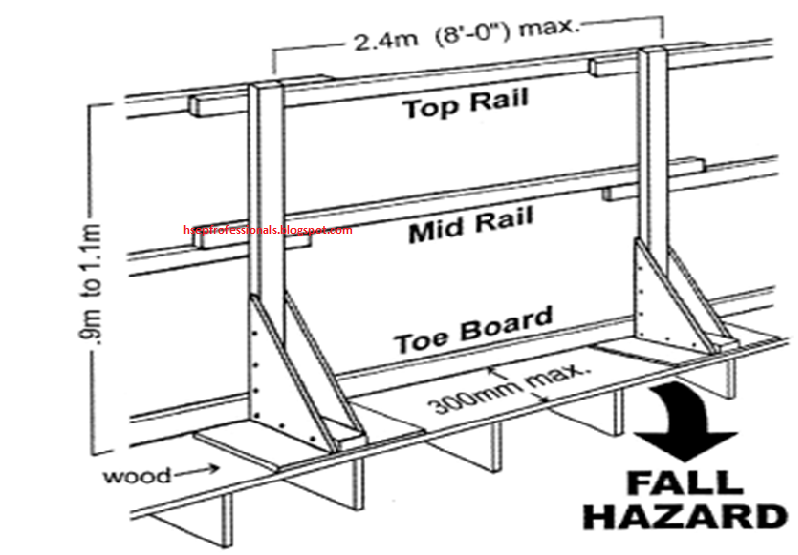
1.     Guardrails are a barrier between you and an open upper level edge. OSHA is very specific about guardrails' design and construction. They're generally about 42 inches high. If there's no wall 21 inches or higher, you have to have mid-rails, screens, or something similar between the guardrails top and bottom to prevent a fall. Guardrails must be made of materials strong enough to stand up against a force of at least 200 pounds. They can't be made of materials that could puncture the skin or snag your clothes.


2.     Safety net systems are designed to catch you if you do fall. They are made with strong border ropes and mesh openings no more than 36 square inches or 6 inches on any side, and placed 30 feet or less under the walking or working surface. Of course, nets have to be strong enough to save a falling person. If they're not certified, employers test them by dropping a 400-pound bag of sand about 30 inches in diameter from the highest walking/working surface. As added protection, OSHA requires us to inspect the nets at least weekly for wear, damage, and deterioration. Obviously, if they're no good, they're replaced. The agency also says to remove any material or scrap that falls into a net as quickly as possible.


3.     Personal fall arrest systems are a very valuable form of protection when you work aboveground. You wear a body harness connected to a fixed anchor by a lanyard, lifeline, or deceleration device that can hold your weight so you don't crash to the ground.

4.     Harness straps attach in the center of your back near your shoulders or over your head; they distribute the fall arrest forces around the mid-body. A body belt goes around the waist, but is prohibited for use after January 1, 1998. If you start to fall, a personal fall arrest system goes into action by the time you've fallen six feet and before contact with any lower level. Once it comes into play, it must bring the falling person to a complete stop after falling no more than 3 1/2 feet.


The only purpose of a personal fall arrest system is to keep you from falling. Don't use one to hoist materials. You must also inspect the equipment before each use to make sure there's no damage or deterioration. If you spot any problems, you turn the system in and get a new one. Any equipment is only as good as its parts. With personal fall arrest systems, the connectors that link the parts together are especially vital. The regulation details what materials meet its standards and how much they have to be able to hold without breaking.

People who work on walls or other elevated vertical surfaces get special fall arrest systems known as positioning devices. They allow you to lean and have both hands free to perform your job. These devices must support at least twice the potential load of an employee's fall and assure that you can't fall more than two feet before they kick in. They need especially tough connectors.

Those are the three fall protection systems OSHA prefers. But, as I mentioned earlier, the agency permits other forms of protection in certain situations.

Warning line systems are rope, wire, or chain barriers that alert employees to an unprotected roof side or edge. Alone, they're not enough protection. We must use them with guardrail, safety net, and/or personal fall arrest systems or with a safety monitoring system.

Warning lines are at least six feet from the roof edge and go around all sides of the roof work area. Needless to say, no one can work between the roof edge and warning line unless they're roofing in that area. Controlled access zones are areas where certain work like overhand bricklaying can be performed without guardrail, safety net, or personal fall arrest systems. As the name indicates, these areas are off limits to all but specially authorized people. Lines of rope, wire, tape, etc. set off these zones. The lines are at least six feet from the unprotected edge—10 feet for overhand bricklaying. They run the full length of that edge, and connect to a guardrail system or wall on each end. Safety monitoring systems are another alternative form of fall protection OSHA permits in certain situations. With safety monitoring, you place a trained person with the workers on the elevated walking/working surface. This person's job is to look for fall hazards and warn employees when they're approaching danger. The monitor has to be in a spot where his or her spoken warning can be heard. And when you hear that warning you'd better follow orders!

We can use safety monitoring along with a warning line system on low-slope roofs or alone on roofs less than 50 feet wide. Employers may also use it in situations where they demonstrate that they can't use guardrails, safety nets, and personal fall arrest systems or that those systems would create a greater hazard than they prevent.
Covers can keep people from falling through holes in floors, roofs, etc. The covers are color-coded or marked HOLE or COVER so you know there's a hazard. They have to be secured so they won't move accidentally and able to support at least twice the weight of employees, equipment, and materials that could be on them at once.

Safety Procedures

It's not easy to remember all these fall hazards and protection systems. Fortunately, you don't have to decide what to use and when. OSHA makes that an employer responsibility. It's your responsibility to take these hazards seriously and to use any protections provided properly. Otherwise, you put yourself or others at risk.


One important employee responsibility is to inspect the personal fall arrest system before you use it. Turn in anything that has:
·        Cuts, tears, or abrasions
·        Undue stretching
·        Mold
·        Deterioration
·        Distorted hooks or faulty hook springs
·        Nonfunctioning parts
·        Loose or damaged mountings
·        Tongues that don't fit the shoulder of buckles
·        Contact with fire, acid, or other corrosives
·        Alterations or additions that limit its effectiveness.

For a personal fall arrest system to protect you, you need a proper and secure anchorage. Sometimes anchorages are designed into a structure. Then window washers and others can use them later. Other options include a steel member or I-beam; steel eye-bolts, guardrails or railings designed for anchor use; and certain masonry or wood pieces. Someone with technical knowledge will determine if possible anchors are strong and secure enough for the task.

You want to be just as sure that the anchor connections are strong. If you use a knot to tie-off, it can reduce the strength of the lifeline or lanyard by 50 percent or more - no matter how strong the anchor it's tied to. To offset that loss, we use a stronger lanyard or lifeline to compensate.
Try not to tie-off over a rough or sharp edge, which can also weaken the line. If you tie off to an "H" or "I" beam, you have to use lanyards made of webbing or lifelines with wire cores because they're stronger and less likely to be damaged by the edge. Some types of knots also limit the system's strength and fall protection ability. Never use a one-and-one sliding hitch knot, and try to avoid using any hitch knot.

Other Fall Prevention Techniques

We've talked about how OSHA-required systems and equipment can prevent construction falls—and deaths and injuries. But as you know, equipment and procedures are never quite enough. You need a cautious, safety-oriented attitude and must take precautions to reduce the chance that you'll fall.

Here are some safety procedures that will help you prevent falls on any level—but especially from heights:
·        Wear sturdy shoes with nonskid soles. Be sure the shoes have either short laces or buckles or snaps.
·        Avoid wearing long, loose pants you could trip over.
·        Walk slowly and watch where you're going—don't run.
·        Clean up all spills promptly.
·        Take special care on wet or icy surfaces.
·        Don't carry a stack of materials you can't see over.
·        Carry only the tools and materials you need to upper levels.
·        Keep all materials as far away from the edge as possible.
·        Dispose of trash regularly and properly.
·        Stay away from edges, even if they're guarded, unless you're performing a specific task there.
·        Obey verbal warnings, signs, and barriers. Don't enter a controlled access zone without authorization.

Wrap-Up

No one wants to end up like Humpty Dumpty and take a big and fatal fall. OSHA's construction fall protection standard was created to make that a lot less likely. By requiring protection when you're at least six feet up, OSHA believes it can really cut the number of falls and related deaths and injuries. The systems, plus the required training programs, are an effort to get all involved parties on the same safety wavelength. The OSHA standard we've been discussing today has a lot of details. It is very specific about when fall protection is required and what equipment is tough enough to do the job.
The standard's careful efforts to prevent falls emphasizes how serious these accidents are. It demonstrates that we can and should prevent falls whenever any job—not just construction—involves work aboveground.